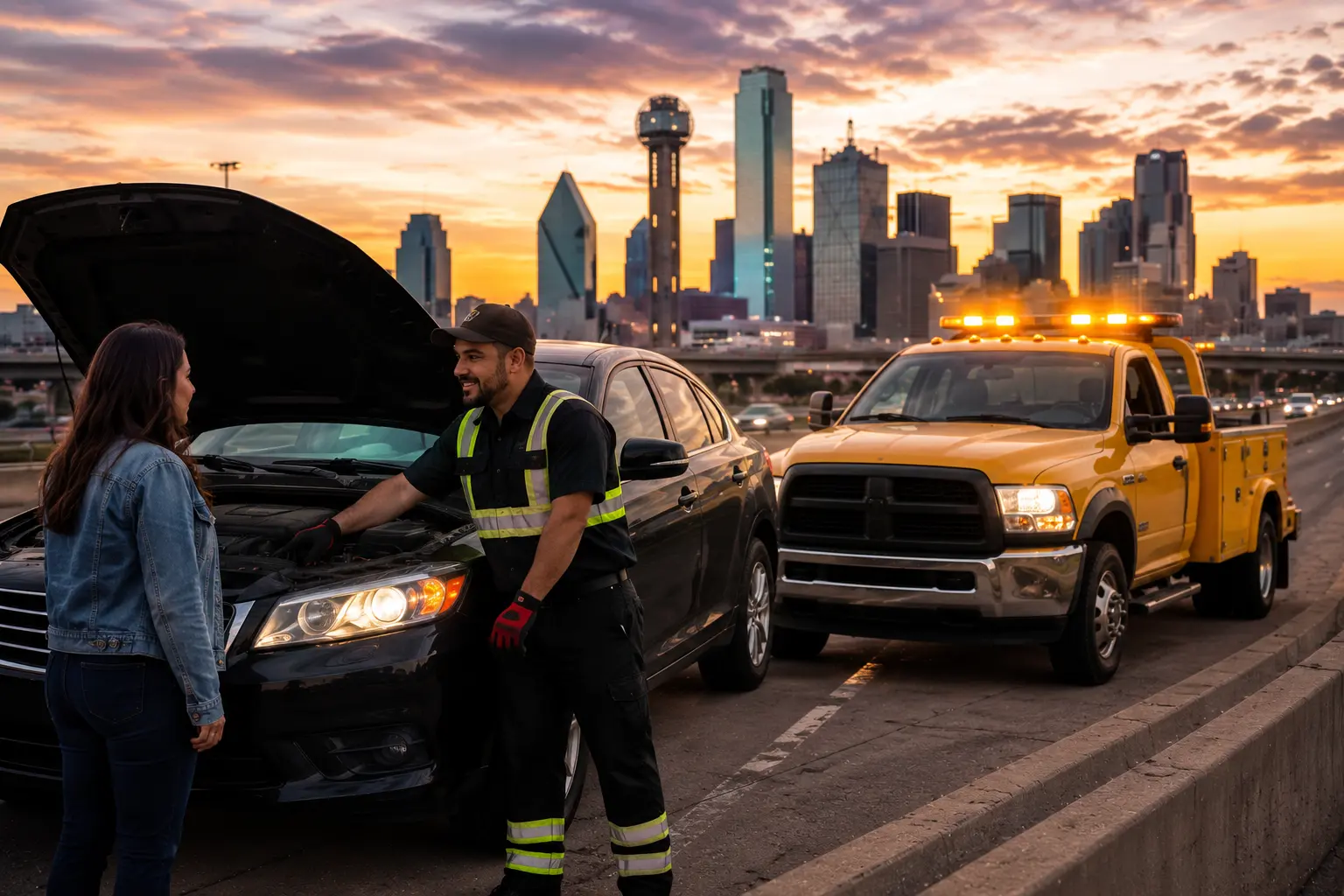
Emergency roadside assistance is something every DFW driver hopes they’ll never need — but statistics tell a different story. AAA reports that tens of millions of drivers across the U.S. require roadside help every single year, and the Dallas–Fort Worth Metroplex, with its massive highway network and extreme weather swings, is no exception.
Whether it’s a dead battery in a downtown parking garage, a blowout on I-635, or an overheated engine on a 105°F Texas afternoon, breakdowns happen without warning. Knowing the most common causes of roadside emergencies — and what to do when they happen — can mean the difference between a minor inconvenience and a dangerous situation.
If you’re already in a situation right now, don’t wait — contact our DFW roadside assistance team or call us directly at (682) 427-9295. We’re available 24/7.
Dead or Failing Car Battery
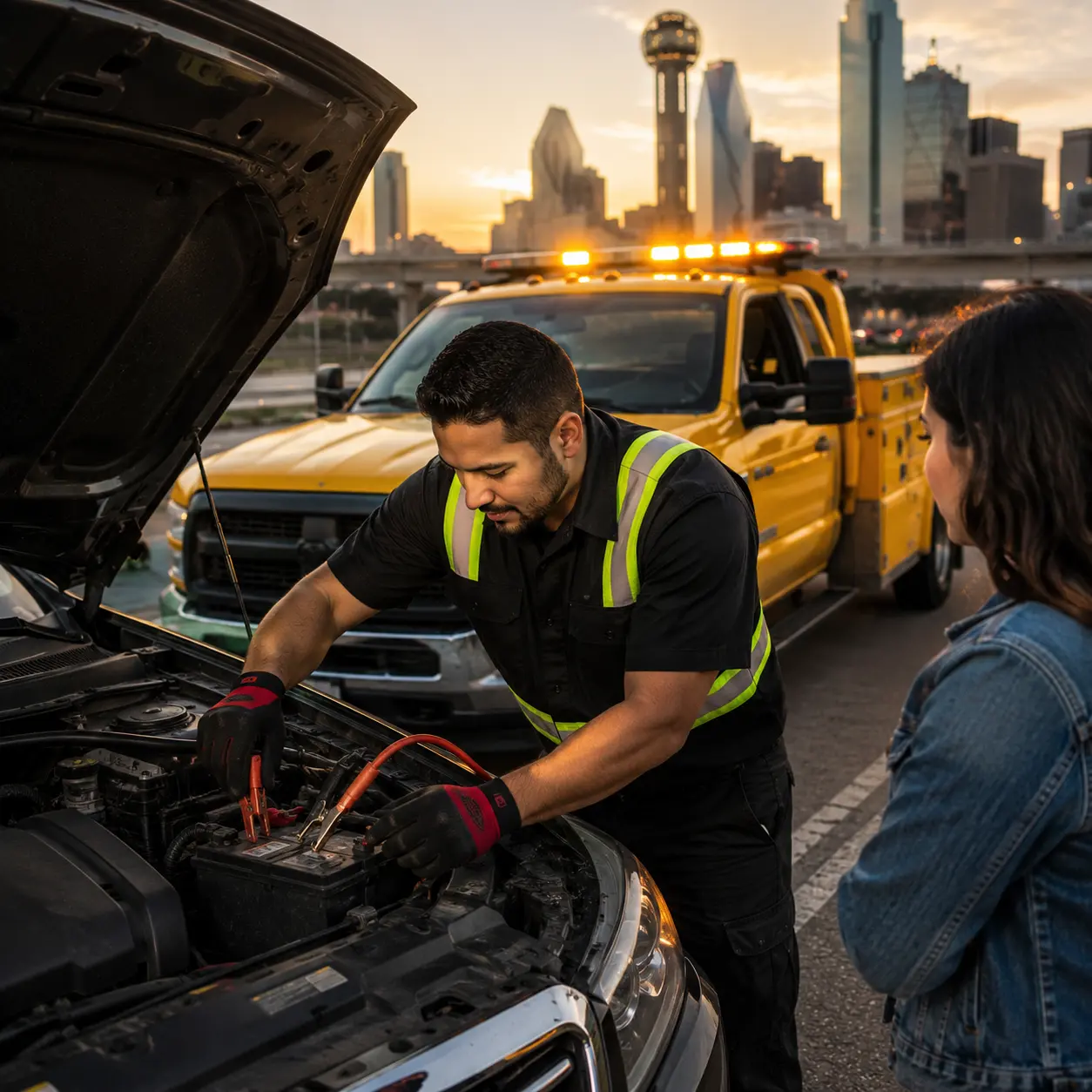
The single most common reason drivers call for emergency roadside assistance in DFW is a dead or weak battery. Texas heat is one of the most destructive forces a car battery faces — extreme temperatures cause the battery fluid to evaporate and accelerate internal corrosion, dramatically shortening its lifespan.
Most car batteries last 3–5 years under normal conditions, but in the Dallas heat they often fail closer to the 2–3 year mark. The frustrating part is that battery failure rarely comes with a clear warning. One morning the car starts fine; the next it doesn’t start at all.
Warning Signs of a Failing Battery
Flat Tires and Blowouts
Flat tires are the second leading cause of emergency roadside assistance calls across DFW. Dallas roads are notoriously rough — construction debris, potholes, and road surface cracking from heat expansion create constant hazards for tires, especially on high-traffic corridors like I-30, US-75, and I-635.
A slow leak can be managed if caught early, but a sudden blowout at highway speed is a genuine emergency. When a tire blows at 70+ mph, the vehicle can pull sharply to one side, and panicked overcorrection is a leading cause of secondary accidents.
What to Do During a Blowout
Engine Overheating
Engine overheating is a particularly common cause of emergency roadside assistance calls in DFW during the summer months. When outdoor temperatures regularly hit 100–110°F and road surfaces can exceed 150°F, cooling systems are pushed to their absolute limits — especially in stop-and-go traffic on the Mixmaster or I-35E.
Overheating is serious. Continuing to drive an overheated engine — even for a few extra miles — can warp the cylinder head, damage head gaskets, and cause complete engine failure. What starts as a $200 coolant repair can become a $4,000+ engine replacement.
What to Do When Your Engine Overheats
Running Out of Fuel
It sounds simple, but running out of fuel is consistently one of the top reasons people call for emergency roadside assistance in DFW. Long highway stretches between exits, unexpected traffic that burns through a low tank, or simply miscalculating the distance to the next gas station — it happens to experienced drivers every day.
Running dry on a DFW freeway at rush hour creates an immediate danger. The vehicle becomes a stationary obstacle in or near fast-moving traffic, and many drivers aren’t sure what to do next.
Modern fuel delivery as part of emergency roadside assistance means you don’t have to walk to a gas station or wait for a friend. Our team brings fuel directly to your location so you can get back on the road as quickly as possible.
Locked Out of Your Vehicle
Vehicle lockouts are among the most frustrating — and surprisingly frequent — reasons drivers need emergency roadside assistance. Keys locked inside, a fob battery that dies without warning, or a malfunctioning electronic lock system can leave you stranded anywhere: a parking lot, a side street, or a rest stop off I-20 at 11 p.m.
Lockouts also carry a safety dimension. If a child or pet is accidentally locked inside a vehicle in Texas summer heat, it becomes a life-threatening emergency within minutes. In those cases, call 911 first.
For standard lockouts, professional emergency roadside assistance uses specialized tools to unlock your vehicle without damage — faster and safer than attempting to break in yourself.
Transmission and Mechanical Failures
Sudden mechanical failures — a snapped serpentine belt, a seized transmission, broken CV axle, or catastrophic oil loss — can bring a vehicle to a complete stop with no warning at all. These situations always require professional emergency roadside assistance and typically a tow, since driving the vehicle would cause further and more expensive damage.
Mechanical failures are especially dangerous on high-speed DFW corridors because the vehicle may lose power steering and power brakes simultaneously, making it harder to guide the car safely to the shoulder.
Common Mechanical Emergencies We Handle
Accidents and Collision Recovery
Traffic accidents are unfortunately a daily reality on DFW’s congested roadways. Whether a minor fender bender in a Dallas parking lot or a serious multi-vehicle incident on I-20, most accidents leave at least one vehicle unable to be driven — making professional emergency roadside assistance and towing essential.
After a collision, your priorities should be: safety, documentation, and then vehicle recovery. Once everyone is safe and you’ve exchanged information and documented the scene, our team can coordinate the tow and work directly with your insurance provider.
After an Accident: What to Do
Flooded or Storm-Damaged Vehicles
DFW is no stranger to severe weather. Flash flooding, hailstorms, and high-wind events can strike quickly and with devastating force — leaving vehicles stranded in high water, damaged by debris, or simply unable to start after a severe storm. These situations demand immediate emergency roadside assistance with specialized equipment.
If your vehicle has been in standing water, the single most important rule is: do not attempt to start it. Water in the engine causes hydrolocking — the engine tries to compress a liquid instead of air, which can bend connecting rods and destroy the engine in a single turn of the key. Call for emergency roadside assistance immediately and wait for a professional assessment.
Hail damage, while less mechanically urgent, can still leave your vehicle unsafe to drive if windshields are cracked or if roof/door deformation affects door sealing or structural integrity.
How to Reduce Your Risk of Needing Emergency Roadside Assistance
While you can’t prevent every breakdown, consistent vehicle maintenance eliminates the majority of common roadside emergencies. Here’s what DFW drivers should stay on top of:
Have questions about keeping your vehicle road-ready in the DFW heat? Reach out to our team — we’re happy to help.
Why DFW Drivers Trust Urgent Tow Network for Emergency Roadside Assistance
When you need emergency roadside assistance in Dallas–Fort Worth, you need a team that answers fast, dispatches faster, and knows DFW roads inside and out. Here’s what makes Urgent Tow Network different:
We serve the entire DFW Metroplex — Dallas, Fort Worth, Irving, Garland, Plano, Arlington, Mesquite, Grand Prairie, Carrollton, Richardson, and everywhere in between. For more information about our services, visit the Texas Department of Licensing and Regulation to verify any towing company you work with, or check NHTSA vehicle safety resources for breakdown prevention guidance.
Final Thoughts: Emergency Roadside Assistance Is One Call Away
Breakdowns are stressful, unpredictable, and often happen at the worst possible time. But knowing the most common causes of roadside emergencies in DFW — and having a trusted emergency roadside assistance number already saved in your phone — turns a dangerous situation into a manageable one.
From dead batteries and flat tires to engine failures and flood recovery, Urgent Tow Network handles every type of roadside emergency across all of Dallas–Fort Worth, 24 hours a day, 7 days a week. When you call us, you’re not reaching a national call center — you’re reaching a real local team that dispatches a real truck to your exact location as fast as possible.
Don’t wait until you’re stranded. Contact Urgent Tow Network today, save our number, and share this guide with every DFW driver you know.