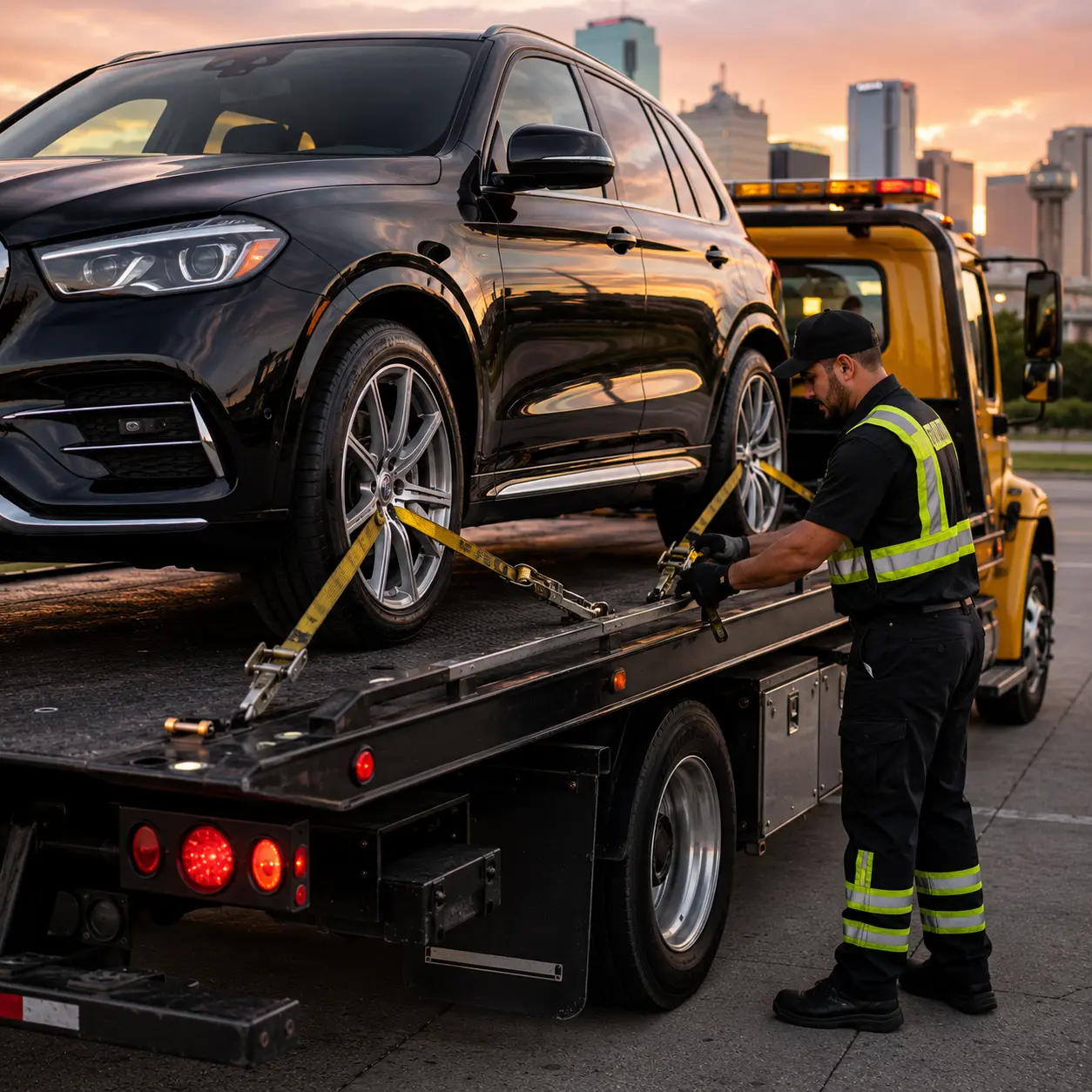
Flatbed towing is one of the most searched terms when Dallas drivers need a tow — and for good reason. The type of tow truck that shows up can make the difference between your vehicle arriving safely at the shop or arriving with new damage. Yet most drivers have no idea there’s even a choice to be made.
In this guide, we’ll explain exactly how flatbed towing and wheel-lift towing work, when each method is appropriate, and which one you should request for your specific vehicle. We’ll also cover what to watch out for when a towing company tries to send the wrong truck.
Have questions before you read on? Feel free to contact our Dallas towing team — we’re happy to walk you through the right option for your vehicle.
What Is Flatbed Towing?
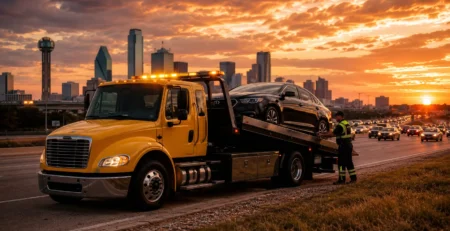
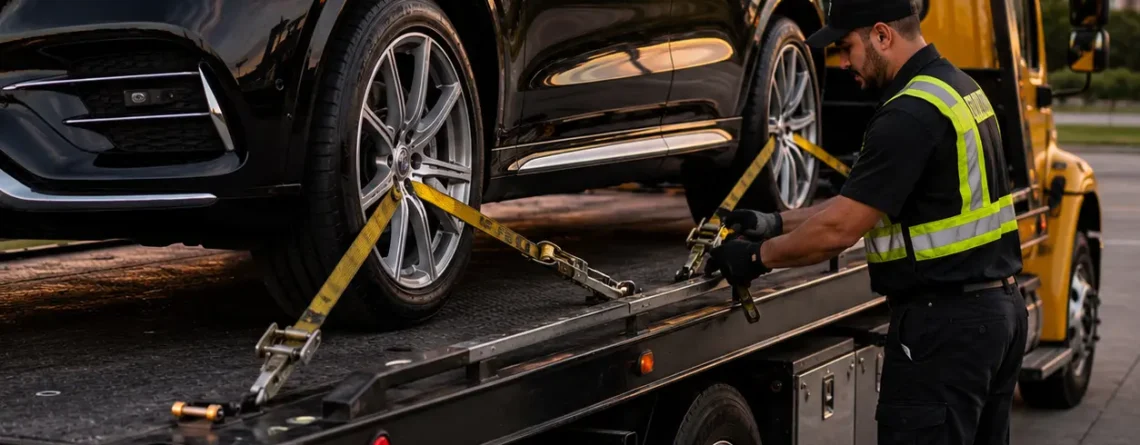
Flatbed towing uses a truck with a long flat platform on the back — known as a flatbed or rollback. The entire platform tilts or slides down to ground level, allowing your vehicle to be driven, winched, or rolled onto it. Once loaded, all four wheels of your car are completely off the ground and secured to the flatbed with straps or chains.
This is the gold standard in vehicle transport. Because no part of your car touches the road during transit, there is zero wear on the drivetrain, transmission, tires, or suspension while being towed.
What Is Wheel-Lift Towing?
Wheel-lift towing uses a metal yoke that fits under either the front or rear wheels of your vehicle. A hydraulic lift then raises those two wheels off the ground while the other two wheels remain on the road and roll freely during transport.
This method evolved from the older hook-and-chain style of towing — it’s faster to set up, cheaper to operate, and works well in tight spaces like parking garages where a full flatbed truck can’t maneuver easily.
However, because two wheels are still rolling on the road, certain vehicle types are at serious risk of drivetrain and transmission damage when towed this way — especially AWD, 4WD, and rear-wheel-drive vehicles.
Flatbed Towing vs Wheel-Lift: Side-by-Side Comparison
Here’s a direct comparison to help you understand the core differences between flatbed towing and wheel-lift towing at a glance:
| Feature | Flatbed Towing | Wheel-Lift Towing |
|---|---|---|
| Wheels on road during tow | ✓ None | 2 wheels rolling |
| Risk of drivetrain damage | ✓ None | Possible / High |
| Safe for AWD / 4WD | ✓ Yes | No |
| Safe for low-clearance vehicles | ✓ Yes | No |
| Safe for luxury / exotic cars | ✓ Yes | No |
| Works with disabled steering | ✓ Yes | No |
| Cost | Slightly higher | Lower |
| Setup time | Slightly longer | Faster |
As you can see, flatbed towing wins on almost every safety category. The slight difference in cost and setup time is almost never worth the risk of drivetrain damage — which can cost thousands of dollars to repair.
When You Should Always Request Flatbed Towing
There are certain situations where flatbed towing is not just the better choice — it’s the only safe choice. Always insist on a flatbed in the following cases:
All-Wheel Drive (AWD) and 4WD Vehicles
AWD and 4WD systems have differentials connected to all four wheels at all times. If two wheels are spinning on the road while the other two are stationary, the differential is forced to work — without engine lubrication. This causes rapid, expensive wear. Flatbed towing eliminates this risk entirely by keeping all four wheels off the ground.
Luxury, Exotic, and Sports Cars
Low-clearance vehicles like Corvettes, Ferraris, BMWs, and similar cars risk scraping their undercarriage when driven onto or off a wheel-lift yoke. A flatbed’s sliding platform brings the loading ramp down to ground level, making it the only viable option for these vehicles.
Vehicles With Transmission or Drivetrain Damage
If the reason you need a tow is related to the transmission, axles, or drivetrain, wheel-lift towing can turn a repair job into a complete replacement. A flatbed towing truck keeps the vehicle completely stationary during transport, preventing any further mechanical stress.
Vehicles Involved in Accidents
After a collision, the structural integrity of your vehicle may be compromised in ways that aren’t visible. Wheel-lift towing applies uneven stress to the frame and axles. Flatbed towing keeps the vehicle level and stable, preserving evidence and preventing secondary damage.
Electric Vehicles (EVs)
Most electric vehicles — including Teslas — must be transported on a flatbed towing truck. EVs use regenerative braking through the drivetrain, meaning rolling wheels generate electrical charge and can cause system conflicts or damage when the car is off. Tesla’s own roadside guide specifies flatbed-only transport.
Vehicles With Locked or Damaged Steering
If the steering column is locked or the front wheels can’t track straight, wheel-lift towing becomes dangerous — the dragging wheels may veer and cause the vehicle to sway or jackknife during transport. A flatbed towing setup secures the wheels in place with no movement at all.
When Wheel-Lift Towing Is Acceptable
Wheel-lift towing isn’t always the wrong answer. There are limited situations where it’s a perfectly practical option — especially when speed and space are the priority:
Common Mistakes When Choosing a Tow Method
Many drivers make avoidable mistakes when it comes to selecting a tow method. Here are the most common ones we see on Dallas roads:
Accepting Whatever Truck Shows Up
Some towing companies dispatch whichever truck is closest — not the right truck for your vehicle. Always ask specifically for flatbed towing when you call. A reputable company will confirm whether your vehicle requires it.
Assuming All Cars Are the Same
A neighbor’s 2005 Toyota Corolla might do fine on a wheel-lift. Your 2023 Ford Explorer AWD will not. The drive system, clearance, and vehicle weight all affect which tow method is appropriate.
Choosing Price Over Safety
Wheel-lift towing is cheaper. But if it causes transmission damage, you’re looking at a $1,500–$4,000 repair bill. The few dollars you saved on the tow become meaningless. Flatbed towing is the smarter financial decision in almost every scenario.
Not Documenting the Vehicle Before Towing
Regardless of which method is used, always photograph your vehicle before it’s loaded. Note any pre-existing damage so it can’t be attributed to the tow. This protects you whether you use flatbed or wheel-lift towing.
Why Urgent Tow Network Uses Flatbed Towing by Default
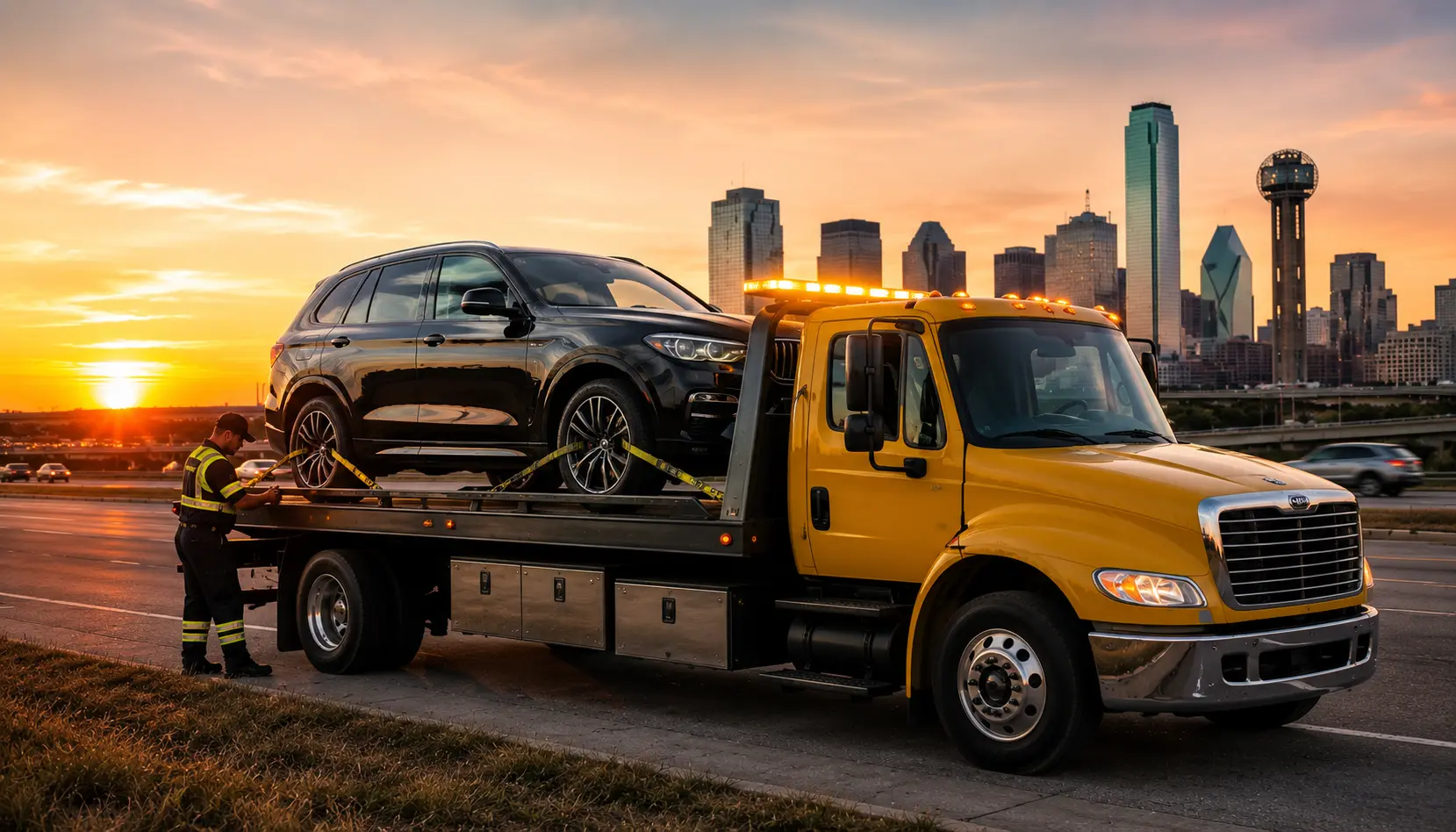
At Urgent Tow Network, our policy is simple: when in doubt, we send a flatbed towing truck. We’ve seen too many cases where a wheel-lift tow caused expensive secondary damage to a vehicle that was already having a bad day. Our drivers are trained to assess your vehicle type on the call and dispatch accordingly — but flatbed is always our first recommendation.
We serve the entire DFW Metroplex — Dallas, Fort Worth, Irving, Garland, Plano, Arlington, Mesquite, Grand Prairie, Carrollton, Richardson — with a modern fleet of flatbed towing trucks positioned across the area for fast response.
24/7 availability · Fast dispatch · Fair pricing
Frequently Asked Questions About Flatbed Towing
Is flatbed towing always more expensive?
Not always. While flatbed towing can be slightly more expensive than wheel-lift, the cost difference is usually minor — often $20–$50 depending on the towing company. Given the potential for thousands of dollars in drivetrain damage with wheel-lift towing, flatbed is almost always the better value.
Does my insurance cover flatbed towing?
Most comprehensive auto insurance policies and roadside assistance plans cover towing — though the specific coverage depends on your policy. Call your insurer before the tow is completed to confirm coverage. Our team can work directly with most major insurance providers.
Can any vehicle be loaded on a flatbed tow truck?
Almost any standard passenger vehicle, SUV, or light truck can be loaded on a flatbed towing truck. Very heavy commercial vehicles or oversized loads may require specialized equipment, but for everyday cars, crossovers, and trucks, a flatbed handles it without issue.
How long does flatbed towing setup take?
In most cases, an experienced operator can have your vehicle secured on a flatbed in 10–15 minutes. The slightly longer setup time compared to wheel-lift is a worthwhile tradeoff for the added safety — especially for high-value or AWD vehicles.
Final Thoughts: Flatbed Towing Is the Safe Default
When it comes to protecting your vehicle during a tow, flatbed towing is the clear winner in almost every situation. It keeps all four wheels off the ground, eliminates drivetrain risk, works safely with AWD and EV vehicles, and is the method recommended by most vehicle manufacturers.
Wheel-lift towing has its place — but only in specific, low-risk scenarios. If you’re ever unsure, just ask for a flatbed. A trustworthy towing company will always give you the honest recommendation for your vehicle type, not the cheapest option that fits their schedule.
Ready to talk to someone who knows their stuff? Contact Urgent Tow Network and we’ll make sure you always get the right truck for your vehicle — every time.